
- Aug 5, 2025
Regulating Emotions at the Root: How Reflex Integration Balances the Autonomic Nervous System
Have you ever wondered why some children seem to be stuck in a loop of emotional reactivity—swinging between anxious outbursts, meltdowns, and shutdowns, despite consistent behavioral support or therapy? One often-overlooked contributor lies in the nervous system’s foundational wiring: primitive reflexes.
What Are Primitive Reflexes?
Primitive reflexes are automatic movement patterns present at birth that help infants survive and begin interacting with their environment. These include reflexes like the Moro (startle), ATNR (asymmetrical tonic neck), STNR (symmetrical tonic neck), and TLR (tonic labyrinthine). Normally, these reflexes are inhibited during the first year of life as higher brain centers mature and take control.
But when these reflexes remain active—or are retained—they can interfere with motor development, sensory processing, attention, and, importantly, emotional regulation.
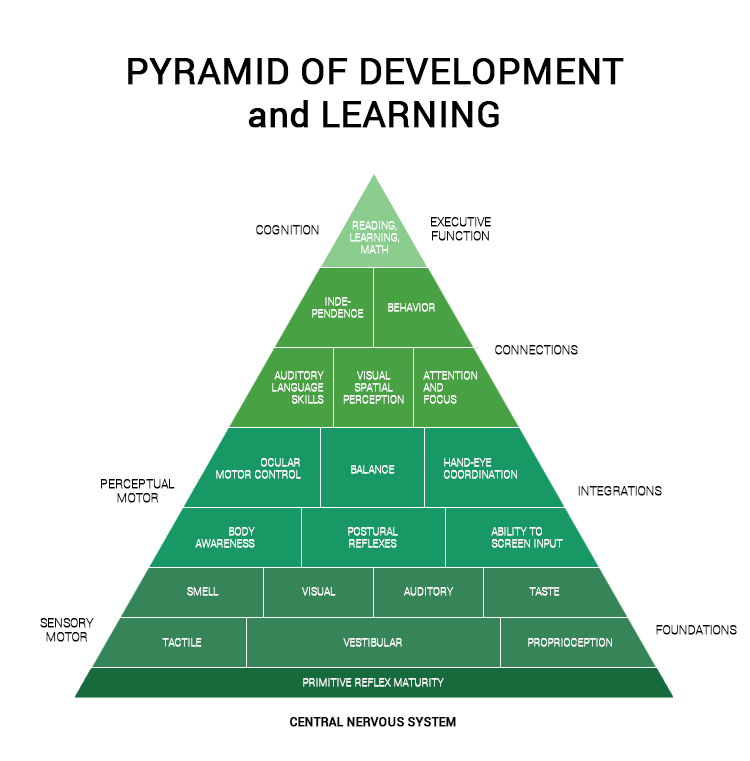
Reflexes are the foundation of the pyramid—supporting everything above.
When primitive reflexes are retained, they disrupt motor control, sensory processing, attention, and emotional regulation. Integrating these reflexes creates the stability the brain needs for higher learning and behavior to flourish.
Reflexes and the Nervous System
Each retained reflex signals an immature neurological pathway. For example:
The Moro reflex, when retained, keeps the body in a chronic state of “fight or flight,” leading to over-reactivity, hypersensitivity, and poor stress tolerance.
The TLR and STNR affect posture and muscle tone, which are tied to proprioception and physical grounding—key components in developing a sense of safety and calm.
The Spinal Galant reflex can increase restlessness and sensory defensiveness, often contributing to anxiety and distractibility.
When these reflexes remain active, the sympathetic nervous system (which governs the “fight or flight” response) can become dominant, leaving the child in a constant state of alertness. This makes it difficult to access the parasympathetic nervous system, which promotes calm, digestion, sleep, and recovery.
Integrating Reflexes to Improve Emotional Regulation
Reflex integration therapy uses repetitive, developmentally based movement patterns to help the nervous system complete the integration process it missed in infancy. As these reflexes are integrated, the brain shifts out of survival mode and into a more regulated state.
Benefits of reflex integration often include:
Reduced emotional outbursts and anxiety
Improved ability to self-soothe
Greater frustration tolerance
Better sleep and digestion
Increased capacity for focused attention and social interaction
This happens because the brainstem reflex patterns quiet down, allowing the prefrontal cortex—the brain’s control center for regulation and decision-making—to take over. This neurological shift creates a better balance between the sympathetic and parasympathetic branches of the autonomic nervous system.
Scientific Evidence
Research supports the neurological connection between reflex integration and emotional or behavioral regulation:
Konicarova, J., & Bob, P. (2013) found that children with ADHD had a significantly higher prevalence of retained primitive reflexes, particularly the ATNR and STNR, compared to controls. (Neuropsychiatric Disease and Treatment, 9, 1457–1461)
McPhillips, T., & Jordan-Black, J. A. (2007) showed that a movement-based program to integrate retained reflexes resulted in improvements in reading, writing, and behavior among school-aged children. (Research in Developmental Disabilities, 28(1), 11–20)
Porges, S. W. (2009) introduced the Polyvagal Theory, which highlights the importance of vagal tone (parasympathetic activity) in emotional regulation, social connection, and behavioral flexibility. Reflex integration supports the nervous system in achieving this calm, connected state.
The Bottom Line
When children (or adults) have trouble regulating emotions, it may not be a purely psychological or behavioral issue—it may be neurological. Reflex integration offers a movement-based, brain-based path to help the body feel safe, which is the essential foundation for emotional balance.
If you're noticing that your child is constantly anxious, easily overwhelmed, or stuck in reactivity, looking at the primitive reflexes could reveal a powerful piece of the puzzle.
Download our free Primitive Reflex Checklist to determine whether or not your child may be affected by retained reflexes. If the checklist is positive - it will be best to seek professional advice. Brain Connex Therapy offers individualized support and guidance through our reflex integration programs.
At Brain Connex Therapy, we specialize in identifying and integrating retained reflexes to restore balance to the nervous system. With the right movement tools, emotional regulation doesn’t have to be a struggle—it can become a skill.
Learn more about Our Approach and Online Programs below.